Commercial Voice Over Guide Styles Scripts and AI Tips | RemotionAI Blog
commercial voice over · voice over styles · AI voice over · ad voice acting · voice over script
Learn what commercial voice over is, styles, script timing, AI vs human options and production tips to create ads that convert.
You've built the ad, chosen the product shots, and written a script that looks fine on the page. Then the voice enters, and suddenly the commercial feels too stiff, too rushed, or strangely disconnected from the brand. That moment is common because commercial voice over isn't background audio. It shapes how quickly viewers understand the offer, whether the brand feels credible, and whether the audience keeps watching long enough to act.
Why Your Commercial Lives or Dies on Voice
A viewer scrolls through a living-room feed. One ad opens with a polished but lifeless read, so the message feels like an interruption. The next begins with a relaxed, human delivery that sounds like useful advice from someone who understands the problem. The second ad earns attention before the viewer has consciously decided to stop.

That difference rarely comes from volume alone. Tone tells the audience how to interpret the message. A warm voice can make a new service feel approachable. A controlled, authoritative voice can give a financial product or software platform more weight. An energetic read can create urgency, but too much energy may make a premium product sound cheap.
The voice also carries information that the script can't express by itself. A short pause can highlight a benefit. A slight lift at the end of a phrase can make an invitation sound natural rather than demanding. Precise emphasis can guide attention toward the product name, offer, or next step.
Commercial voice over works alongside music, sound effects, editing, and captions. If you're learning how those elements interact, this guide to what sound design does in video offers useful context. The voice remains the human route through the message, connecting the opening problem to the product and then to the action you want viewers to take.
Practical rule: Choose the voice as early as you choose the visual concept. A voice that doesn't fit can force expensive changes to pacing, music, captions, and edits.
The broader industry context explains why this choice matters. The commercial voice over segment sits inside a global voice-over market estimated at about USD 4.4 billion annually. One widely cited 2017 report placed North America at roughly 19% of global value, while a later 2024 estimate placed the region at around 43.5% of market share, as reported by Voices. Commercial work has long served advertising, corporate video, internet video, and other digital formats at scale.
By the end of the process, you need a voice that matches three things: the audience, the message, and the platform. Get those aligned, and the voice becomes a conversion lever rather than a decorative layer.
What Commercial Voice Over Really Is and How It Works
Think of a commercial voice over artist as a guide walking someone through a short story. The guide introduces the problem, points out the solution, explains why it matters, and shows the viewer what to do next. The voice doesn't read every word. It controls the journey.
A commercial read appears in paid ads, product promos, branded explainers, radio spots, social videos, streaming campaigns, and corporate marketing. The same product may need several performances because each channel creates a different listening environment. A viewer may watch a social ad without sound at first, while a radio listener depends entirely on the voice and audio mix to understand the offer.
The job inside the ad
Commercial voice over usually performs several connected tasks:
- Establishing attention: The opening line needs enough presence or curiosity to compete with the surrounding content.
- Clarifying the benefit: The performer makes the central promise easy to follow, especially when the product is unfamiliar.
- Creating brand personality: The delivery can make a company feel practical, playful, reassuring, premium, or direct.
- Directing the action: The final instruction should sound intentional, whether it asks people to shop, sign up, learn more, or remember a name.
This differs from character work, where the performer builds a fictional personality, and from documentary narration, where the voice often explains events over a longer structure. Commercial performance is usually more compressed and purposeful. Every breath, pause, and emphasis supports a business objective.
Why the market context matters
The category has substantial commercial demand. A later market breakdown estimated the global voice-over services market at USD 5.8 billion in 2025, with commercial services representing 24.5% of revenue, or about USD 1.42 billion, as detailed in the voice-over services market breakdown. That figure places advertising, branded content, explainers, and promotional media at the center of the service category rather than at its edge.
Start by asking what the audience should feel in the first few seconds, what they must understand before the ad ends, and what action should feel easiest. Those answers make casting and direction much clearer than asking for “a good voice.”
Finding the Right Voice Style for Your Brand and Audience
A style choice becomes easier when you connect it to the audience's concern. A meal-delivery service may need a friendly voice that lowers friction. A cybersecurity platform may need calm authority. A luxury skincare brand may prefer restrained confidence instead of an excited sales pitch.
Match delivery to intent
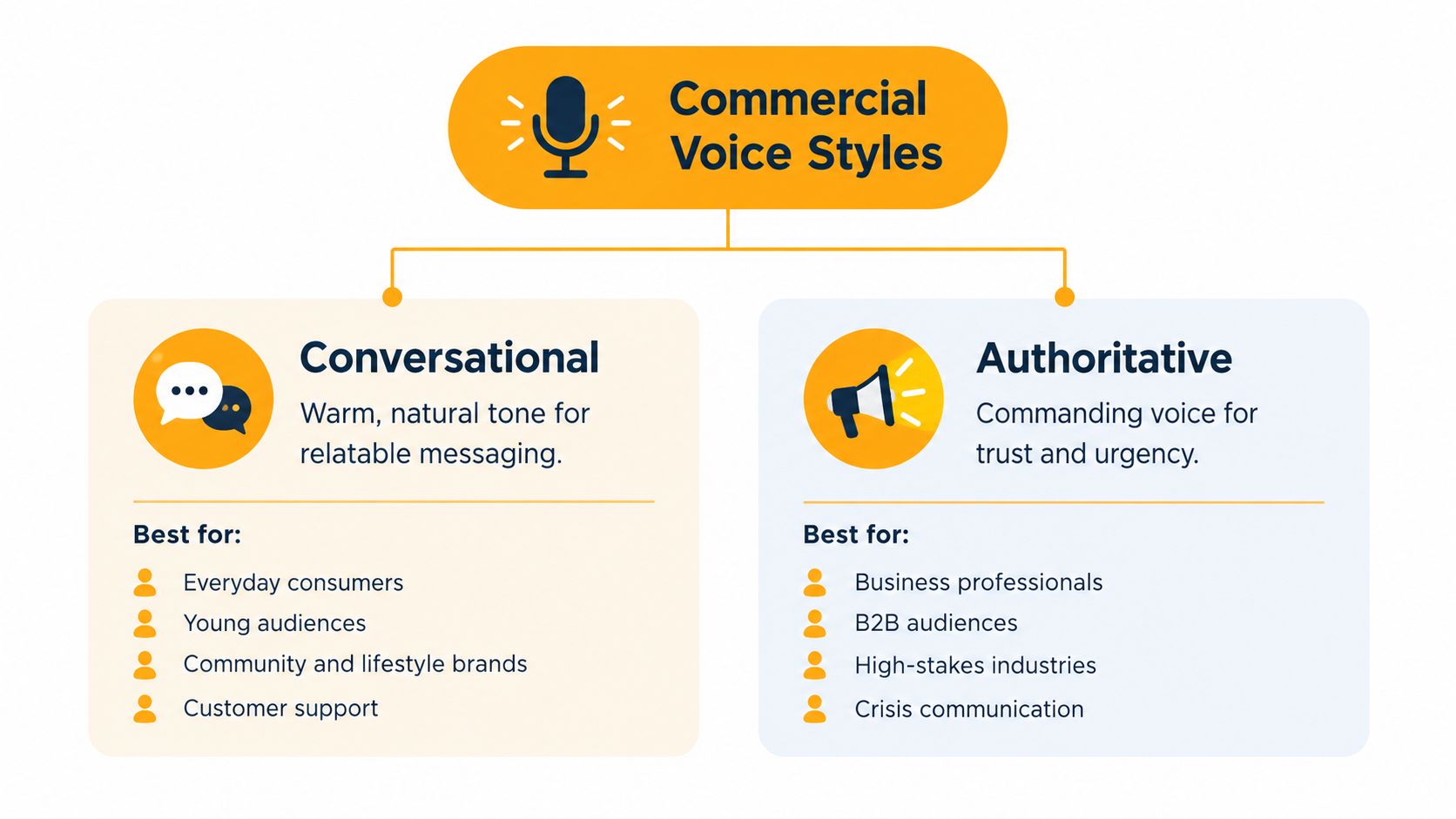
Conversational and friendly works well for consumer apps, home products, lifestyle services, and social ads. The voice should sound prepared but not over-rehearsed, as though a helpful person is explaining a useful discovery.
Authoritative and trustworthy suits financial services, healthcare information, business software, and technical products. The performer needs control and clarity, but authority shouldn't become coldness. The audience should feel guided, not lectured.
Energetic and hard-sell can support a limited-time promotion, retail event, or direct-response campaign. It creates momentum through sharper emphasis and faster movement. Use it carefully when the product depends on calm consideration or a high level of trust.
Warm and empathetic fits wellness brands, family services, customer support products, and messages built around personal difficulty. This style benefits from measured pauses and a tone that acknowledges the viewer's situation before presenting the solution.
Quirky and humorous can help entertainment, snacks, games, and distinctive consumer brands stand apart. The performer needs strong timing, because a joke can disappear if the read buries the setup or rushes the payoff.
Luxurious and aspirational suits premium travel, automotive, fashion, property, and design. The delivery often uses space and restraint. A voice that tries too hard to sound expensive can damage the impression, so direction matters as much as casting.
Make the decision practical
Consider the product's price, the audience's familiarity with the category, and the campaign's main job. A low-friction purchase may benefit from warmth and speed. A complex or expensive purchase usually needs calm explanation and confidence.
You can also test the same script in contrasting styles. Record a conversational take and an authoritative take, then review them with the visuals and captions. The better option is the one that makes the product's intended action feel natural, not necessarily the one with the most dramatic voice.
If you need local casting guidance or want to understand how performers connect with production communities, this resource on connecting with actors in Atlanta can help you think beyond a voice sample and consider communication, availability, and fit.
The commercial category's scale reinforces the value of making this decision deliberately. It isn't enough to select a voice that sounds pleasant in isolation. The right performance should make the brand promise easier to believe.
AI Voice Over Versus Human Talent and When to Use Each
The choice between AI and human talent depends less on ideology than on the production problem. You may need many quick variations for social testing, or you may need one emotionally precise performance that represents the brand for a major launch.
| Need | AI voice over | Human talent |
|---|---|---|
| Speed | Fast generation and revisions | Requires scheduling and recording |
| Cost | Often lower for production experiments | Higher when casting, directing, and recording are involved |
| Consistency | The same voice can repeat a style across versions | Performance can vary between takes |
| Emotional nuance | Useful, but limited by the selected voice and direction | Richer interpretation of subtext and feeling |
| Customization | Controlled through prompts and voice settings | Shaped directly through performance and live direction |
AI voice over is practical when the message changes often. E-commerce teams can generate product variations, social marketers can test different openings, and internal teams can create drafts before committing to a final performance. It also helps when the voice must stay consistent across many short pieces.
Human talent remains valuable when the read depends on subtle intention. A performer can respond to live direction, discover a more natural emphasis, and adjust a line when the emotional meaning changes. Those qualities matter for a hero brand film, a sensitive subject, or a campaign where trust depends on unmistakable human presence.
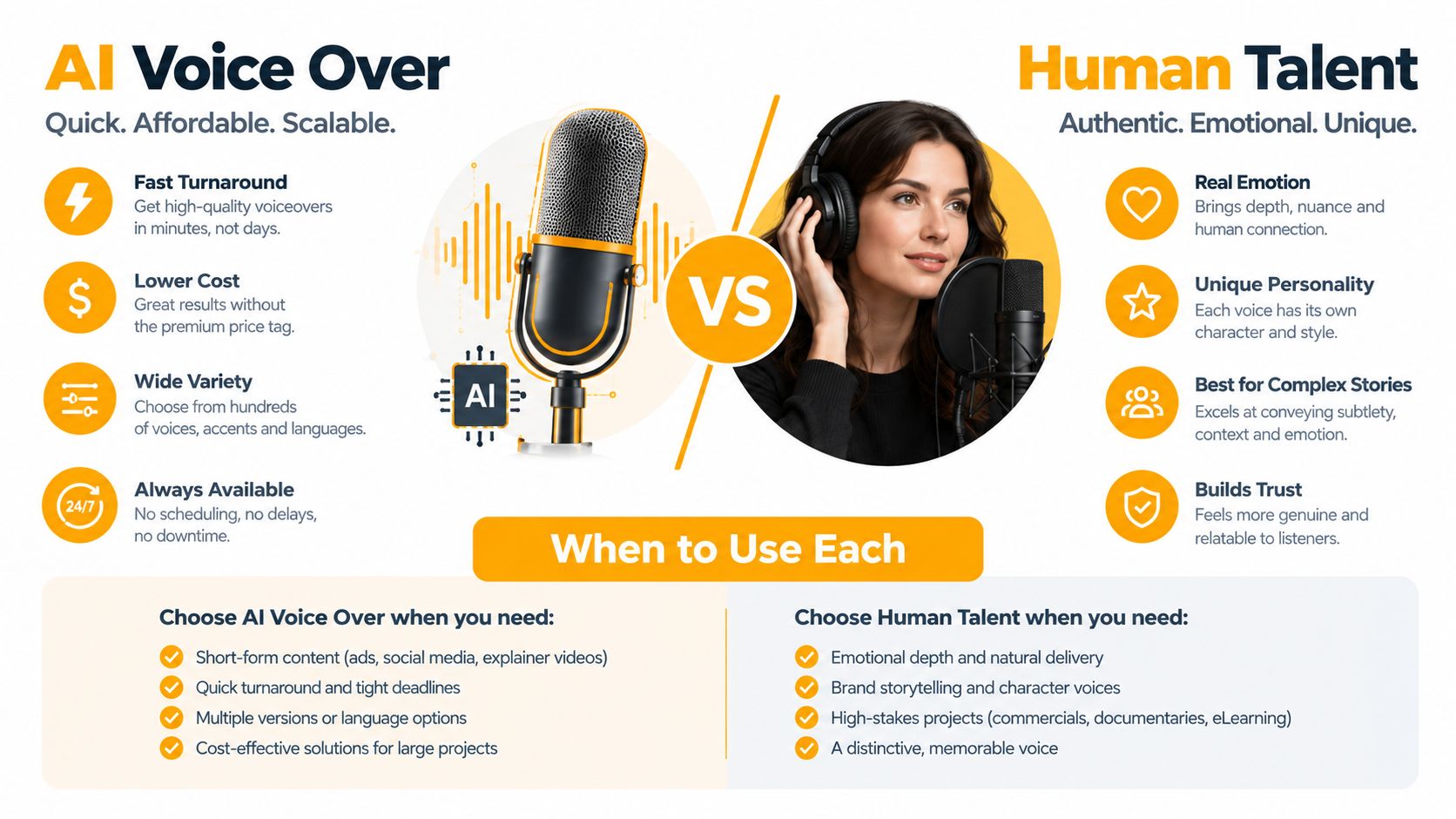
A useful hybrid workflow starts with AI for exploration. You can audition pacing, compare scripts, and check whether the visual edit supports the message. Then you can replace the temporary track with a human performance if the finished campaign needs greater emotional detail.
RemotionAI uses ElevenLabs for AI voiceovers and combines narration with synchronized audio and animated captions inside a video workflow. You can learn more about that approach in this guide to AI voiceover with ElevenLabs. The important point is to treat AI as a production option, not an automatic substitute for direction.
The voice choice should follow the audience's expectations and the campaign's risk, not the novelty of the tool.
How Commercial Voice Over Gets Made From Script to Final Mix
A reliable commercial begins with a clear brief. Define the audience, offer, platform, desired action, brand personality, pronunciation requirements, and delivery format before anyone records. A performer can't solve a vague message through tone alone.
Build the script around the edit
Write the spoken copy alongside the visual plan. Mark the product reveal, key benefit, proof point, and call to action so the voice has a clear path through the images. For practical guidance on voice over pacing and format, pay attention to pauses, sentence shape, and how spoken language differs from copy written for silent reading.
The workflow usually follows this order:
- Brief and cast: Share references, pronunciation notes, audience details, and the intended performance.
- Write and time: Read the script aloud while reviewing the planned visuals. Remove words that don't help the message.
- Direct the performance: Give usable direction such as “sound like a calm expert helping a first-time buyer,” rather than vague notes like “make it better.”
- Record clean audio: Capture a consistent performance with controlled room sound and enough usable takes.
- Edit and sync: Remove distracting gaps, align phrases with visual moments, and leave space for captions and music.
- Finish the mix: Balance voice, music, and effects so the message remains intelligible on the target platform.
- Review versions: Check the opening, product name, offer, and final action on headphones and ordinary speakers.
An automated workflow can reduce handoffs by turning a plain-language idea into Remotion React code, adding AI voiceover, syncing audio, placing animated captions, and allowing preview and refinement before an MP4 render. The advantage is control over the relationship between script, timing, and picture. You can spot a crowded line or weak transition before final delivery.
For a deeper production walkthrough, use this guide to doing a voice over. It helps first-time producers understand why recording, editing, and mixing are separate decisions rather than one single task.
Best Practices for Tone Script Length and Delivery That Converts
A commercial voice over converts more effectively when the listener can process the message without strain. Start with the intended feeling, then make the words and delivery support it. A friendly performance needs room to sound natural. A serious message needs enough space for important details to land.
The standard commercial pacing benchmark is about 140 to 160 words per minute, while a 30-second spot typically allows roughly 65 to 80 words and a 60-second spot about 135 to 175 words, depending on delivery style and pauses, according to this commercial script timing guide.
| Format / Platform | Timing / Loudness Target | Practical Tip |
|---|---|---|
| Short social spot | Keep the script comfortably below the maximum for the chosen duration | Prioritize one benefit and one action |
| 30-second commercial | About 65 to 80 words at standard pacing, with 65 to 70 words often leaving more breathing room, as recommended by this script-writing guide | Protect pauses around the product name and call to action |
| 60-second commercial | About 135 to 175 words, depending on performance and pause allowance | Use a clear progression instead of stacking features |
| Broadcast television | -23 LUFS integrated, with a -1 dBTP true-peak ceiling under EBU R128 | Check the finished mix against the broadcast specification |
| Major streaming platforms | Common normalization around -14 to -16 LUFS, depending on the service | Make a separate digital master when the campaign needs it |
Fast reads may reach 170 to 180 words per minute or higher for hard-sell broadcast spots, while conversational narration is often around 120 to 150 words per minute, as summarized by this voice-over timing reference. Treat those ranges as starting points, not targets to hit at any cost.
Loudness matters because peak level and perceived volume aren't the same thing. EBU R128 uses LUFS, and streaming services commonly normalize around -14 to -16 LUFS. A track mastered only for peak headroom can sound perceptually quiet after normalization, so check integrated loudness and true peak before delivery using this LUFS guidance for voiceover.
For U.S. television advertising, the FCC's CALM Act requires commercials to match the average loudness of adjacent programming using the ATSC A/85 loudness practice. The rule applies to television and MVPD delivery, not internet or streaming ads, as explained by the FCC's commercial sound-volume guidance.
Mixing reminder: Don't ask the voice to compete with the music. Lower the music, simplify the effects, or revise the arrangement before pushing the narration harder.
Your Next Commercial Starts With the Right Voice Choice
A strong commercial voice over begins before the microphone turns on. Decide what the audience should feel, what they need to understand, and what action the platform can support. Then choose the performance that makes those decisions sound believable.
Use conversational delivery when approachability matters. Choose authority when clarity and trust carry more weight. Use energy when the campaign needs momentum, and restraint when the product depends on premium perception. AI can accelerate drafts, variations, and repeatable content, while human talent can bring richer interpretation to moments where emotional nuance carries the brand.
Script length and loudness complete the picture. Leave room for breath and emphasis instead of cramming every benefit into the available time. Finish separate masters when broadcast and digital platforms require different loudness treatment. Review the result with the actual visuals, captions, music, and call to action, because a voice that works in a script document may not work once the edit is moving.
The most useful first test is simple. Create a version that makes one clear promise, pair it with a voice that matches the audience, and compare the result against an alternative delivery. Keep the stronger alignment, then refine the opening, pacing, and final instruction.
RemotionAI turns plain-language video ideas into Remotion React projects with AI voiceovers, synchronized audio, animated captions, brand controls, and platform-ready formats. Visit RemotionAI to create a first commercial draft, test the voice against your script, and refine the complete video before rendering.