How Long Is Too Long: The Creator's Guide to Video Length | RemotionAI Blog
video length · content strategy · social media · creator tips · video marketing
Discover how long is too long for video on TikTok, Reels, and YouTube. Get data-backed length guides and retention strategies for creators.
There is no universal cutoff for video length, but short-form engagement often peaks around 34.69 seconds. Longer videos can still win when viewer intent is high, including medium-length videos of 10–20 minutes and long videos over 20 minutes in some contexts.
You've probably seen the problem firsthand. A carefully edited clip gets ignored, while a seemingly ordinary tutorial keeps viewers watching. The difference usually isn't the camera, the soundtrack, or even the topic. It's whether each second earns the next one.
The useful question isn't just how long a video should be. It's how much value the viewer receives for the time you ask them to spend. That value-to-length ratio, combined with watch time and completion rate, gives you a much better answer than any universal platform rule.
The Myth of the Perfect Video Length
A creator posts a polished 60-second TikTok and watches it disappear. Another spends days making a detailed YouTube tutorial, then sees viewers leave before the explanation reaches its useful part. Both creators may blame the runtime, but length is only one variable in the result.
There's no magic number that guarantees performance. Research describes an inverted U-shaped relationship between video length and engagement, with an optimal point at 34.69 seconds in one recent paper, not a permanent rule for every audience or format (Marketing Trends Congress research).

A short clip can fail if its opening is vague. A longer video can succeed if it answers a serious question quickly and keeps progressing. Platform expectations matter because viewers arrive with different habits, patience, and intent.
Practical rule: Don't cut a video to reach a fashionable duration. Cut every section that fails to create curiosity, understanding, emotion, or action.
The right runtime is therefore strategic. Awareness content often needs immediate impact, while a product demonstration or technical lesson earns more time by solving a larger problem.
Platform Breakdown - TikTok, Reels, and YouTube
TikTok, Instagram Reels, and YouTube reward different viewing situations. Treating them as interchangeable creates weak edits, even when the underlying idea is strong.
TikTok often performs well around 20–35 seconds, according to platform-length benchmarks summarized by Hootsuite's social video guidance. Yet shorter isn't automatically stronger. One large-scale analysis found that TikTok videos longer than 54 seconds achieved 6.7% engagement, compared with 6.0% for clips under 10 seconds, when the added duration delivered enough value (Vidico's short-form video benchmark roundup).
Instagram Reels show a similarly conditional pattern. One analysis found engagement peaks around 45–60 seconds and again around 120–180 seconds, then falls to 0.15% average engagement beyond 180 seconds (Vidico's benchmark summary). That doesn't mean every Reel should be long. It means the idea must justify the runtime.
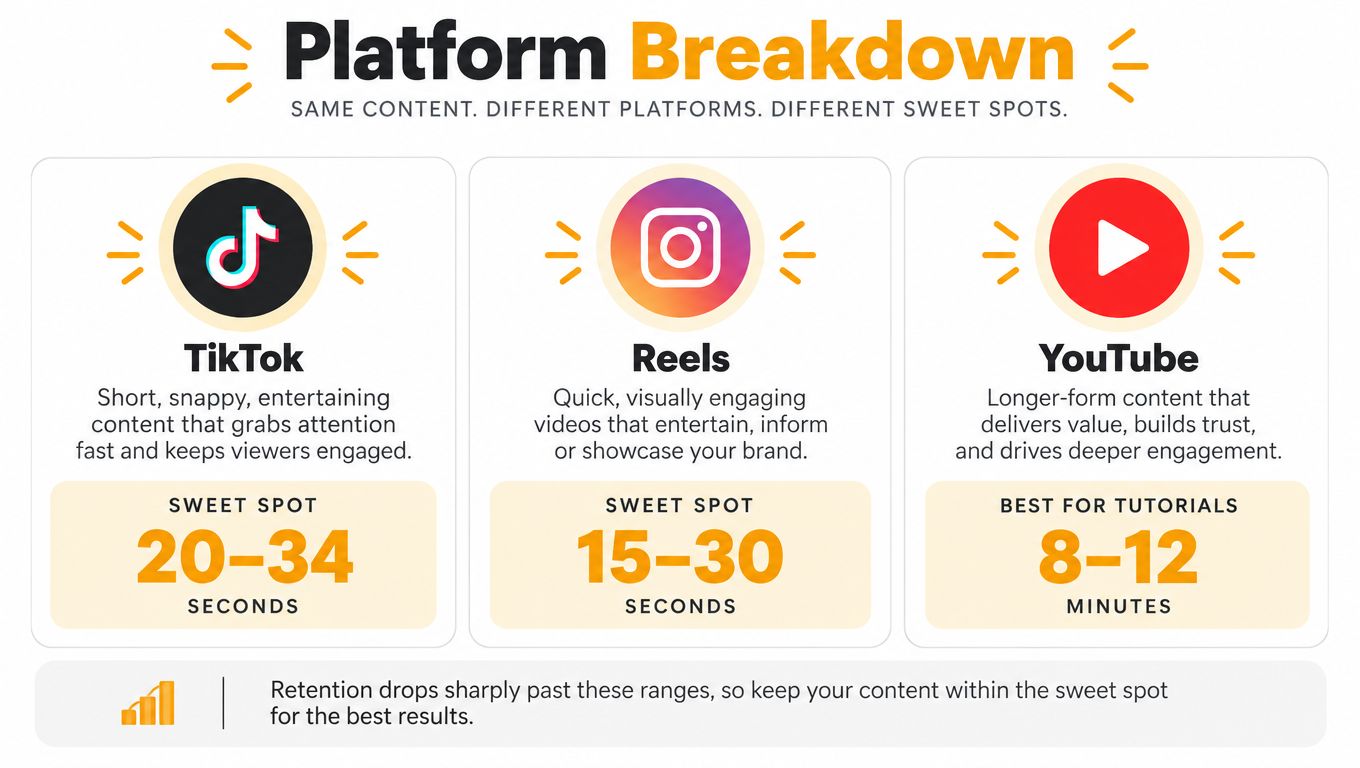
YouTube gives creators more room because viewers often search with a defined problem. A useful tutorial can retain attention far longer than a social clip, provided the structure stays tight. For planning differences between formats, this guide to YouTube video length offers a useful companion perspective.
File limits and recording methods can also affect production choices, so creators comparing TikTok upload versus in-app recording should separate technical maximums from the runtime their audience wants.
The Science of Attention Spans
The opening window has become harder to defend. Research cited in digital attention studies places average screen focus at about 2 minutes 30 seconds in 2004, compared with roughly 47 seconds in later measurements (Marketing Trends Congress research). That doesn't prove people can't watch longer videos. It shows that creators have less time to demonstrate relevance.
Recommendation systems also read behavioral signals. Watch time matters, but so do completion, retention, and rewatch behavior. A 45-second clip with strong average view duration can be healthier than a 15-second clip that loses viewers immediately, because the longer video earns attention proportionally.
Short-form video often faces a practical ceiling around 60 seconds, while educational and high-consideration content can run much longer when it delivers value early and maintains pace (Hootsuite's video-length guidance).
That creates a useful distinction:
- Runtime is the amount of time you publish.
- Retention is the amount of time viewers choose to stay.
- Value density is how much useful or compelling material each moment contains.
A longer format works when value density rises with runtime. If the video adds background, repetition, or slow transitions without increasing payoff, viewers feel the imbalance before they consciously identify it.
For more production guidance on openings, pacing, and structure, these video marketing best practices are worth applying before you start trimming blindly.
When Longer Formats Make Sense
Longer video makes sense when the viewer has a reason to stay. A product tutorial, software walkthrough, detailed comparison, or training lesson can solve a problem that a short clip only introduces.
One cited study found that medium-length videos of 10–20 minutes and long videos over 20 minutes can outperform videos under 10 minutes in some contexts (Marketing Trends Congress research). The condition matters more than the number. Relevance must carry the viewer through the extra time.

Build a longer video around clear progress:
- State the outcome early. Tell viewers what they'll be able to do or understand.
- Create visible sections. Use chapters, visual changes, or concise transitions so the viewer always knows where they are.
- Remove repeated explanations. One strong example beats several similar ones.
- Add pattern interrupts. Change the visual, presenter angle, graphic, or question when attention starts to soften.
Wistia benchmarks summarized by HubSpot report 43% engagement for videos of 3–5 minutes, while how-to videos of the same length reached 74% (Vidico's benchmark coverage). The lesson isn't to copy those runtimes. It's to match structure and intent to the viewer's reason for watching.
Practical Guidelines for Creators
Start with the job the video must perform. A cold-audience teaser should create interest quickly. A tutorial should remove confusion. A sales demonstration should answer objections before asking for a click.
Then inspect the retention graph rather than celebrating raw views. If viewers leave during the setup, shorten the opening. If they stay through the explanation but exit before the call to action, move the relevant next step earlier or make the payoff clearer.
A practical workflow looks like this:
- Write the promise first. If you can't explain the video's outcome in one sentence, the edit will probably wander.
- Draft the shortest useful version. Add time only when an example, proof point, or explanation improves understanding.
- Review every drop-off. A retention dip often identifies a slow transition, repeated point, unclear phrase, or weak visual.
- Adapt the same idea by platform. A long tutorial can become several focused clips, each with its own hook and conclusion.
Creators developing recurring formats can also use these actionable vlog ideas for 2026 to test different subjects without forcing every concept into the same duration. For temporary updates, this guide to Instagram Story length helps separate a format's technical boundaries from the audience's attention needs.
RemotionAI can turn plain-language ideas into platform-ready videos with Remotion React code, AI voiceovers, synchronized audio, captions, and vertical or horizontal templates. That makes it easier to create multiple cuts of the same concept and compare how different runtimes affect retention.
Conclusion - Finding Your Balance
“How long is too long?” has no useful answer without context. The actual breaking point arrives when the viewer's perceived payoff grows more slowly than the time you're asking them to invest.
Short-form creators should protect the opening, keep one clear idea in each video, and watch completion signals. Long-form creators should earn every additional minute with deeper explanation, stronger examples, or a more satisfying narrative.
The best video isn't the shortest one. It's the one that delivers the most meaningful engagement per second without rushing the message. Test different openings, runtimes, pacing choices, and endings. Then let retention show you where the audience found value and where you asked for too much patience.
Use RemotionAI to turn one idea into multiple platform-ready cuts, then compare how each version performs across TikTok, Instagram, and YouTube. Create the shortest version that preserves the message, and refine longer edits only when the added depth earns continued attention.