What Is Video Marketing and How It Drives Growth | RemotionAI Blog
what is video marketing · video marketing strategy · video marketing ROI · social video marketing · RemotionAI
Learn what is video marketing, its top formats, benefits, metrics and workflow to create platform-ready videos that convert across TikTok, Reels and YouTube.
Video marketing is the strategic use of video across the full funnel to attract, engage and convert audiences, now used by 91% of businesses as a core budgeted discipline. It's also treated as a serious performance channel: 93% of video marketers say video is an important part of their strategy, 82% say it delivers good ROI, and 92% plan to spend the same or more on video in 2026.
If you're asking what video marketing is, you're probably not looking for a dictionary definition. You're trying to figure out whether the product clip on your phone, the tutorial on your site, the Reel you keep meaning to post, and the ad variant your team needs by Friday all count as the same thing. They do.
First understand video marketing from the viewer side. You scroll, stop on a short clip, watch a product in action, tap through, and either buy, save, or keep researching. From the marketer side, that whole chain matters. The video didn't just “get views.” It created discovery, built trust, and pushed the next step.
What Video Marketing Really Means Today
A shopper sees a 30-second skin care clip while waiting in line for coffee. The creator shows the texture, the before-and-after feel, and one clear reason it solves a problem. The shopper doesn't buy right away, but later searches the brand on YouTube, watches a demo, lands on the product page, and converts. That is video marketing in its modern form.
It's not just posting videos because every platform wants them. It's using video on purpose to move someone from first contact to action. That action might be a sale, a sign-up, a product page visit, a demo request, or even a return visit after someone wasn't ready the first time.
Here's a simple way to think about it visually:
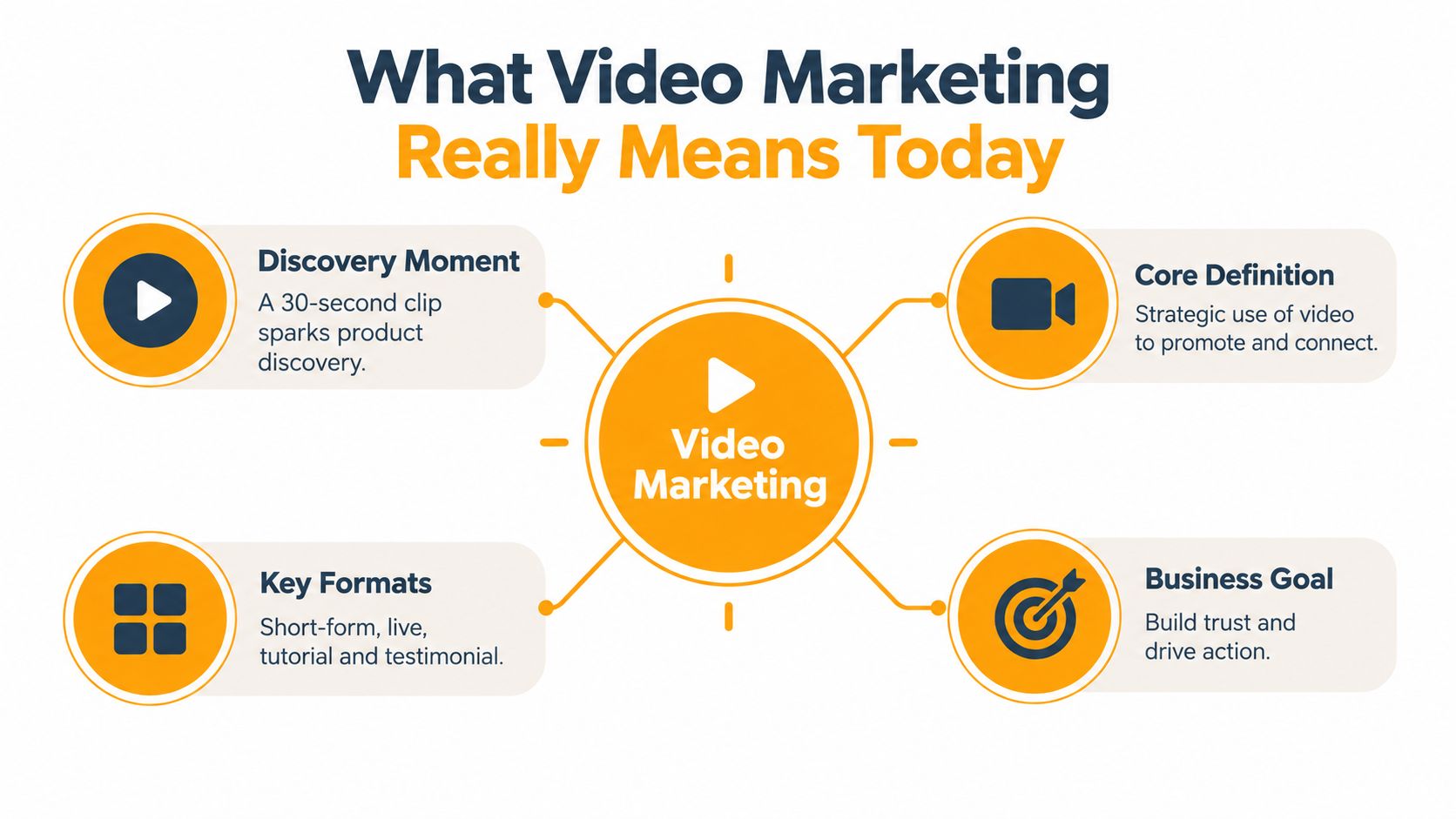
It's a system, not a single asset
A lot of confusion comes from treating video as one finished piece. In practice, one idea often becomes many versions. A founder story becomes a YouTube explainer, three Reels, a product-page demo, a silent paid ad with captions, and a localized version for another market.
That shift happened because video moved from specialty format to standard practice. A 2026 benchmark reports that 91% of businesses use video as a marketing tool, up from 61% in 2016. The same benchmark says 93% of video marketers see it as an important part of strategy and 82% say it delivers good ROI, which shows why teams now plan for video as a core channel rather than a nice extra (Wyzowl video marketing statistics).
Practical rule: If a video has no job in the customer journey, it's content. If it's designed to move someone to the next step, it's marketing.
What people usually miss
Beginners often assume video marketing means brand storytelling only. That's too narrow. It can absolutely tell stories, but it also explains, proves, compares, reassures, and sells.
If you want help turning campaign ideas into useful prompts before production starts, this roundup of AI prompts for video campaigns gives practical angles to work from. And if your focus is platform-native execution, this guide to social media video marketing is a useful companion because it shows how social distribution changes the way you plan the asset itself.
How Video Marketing Works as a System
Think of video like a storefront.
First, it has to make people stop walking. Then it has to make them curious enough to step inside. Then it has to help them buy without friction. Most weak video campaigns fail because they focus on only one of those jobs.
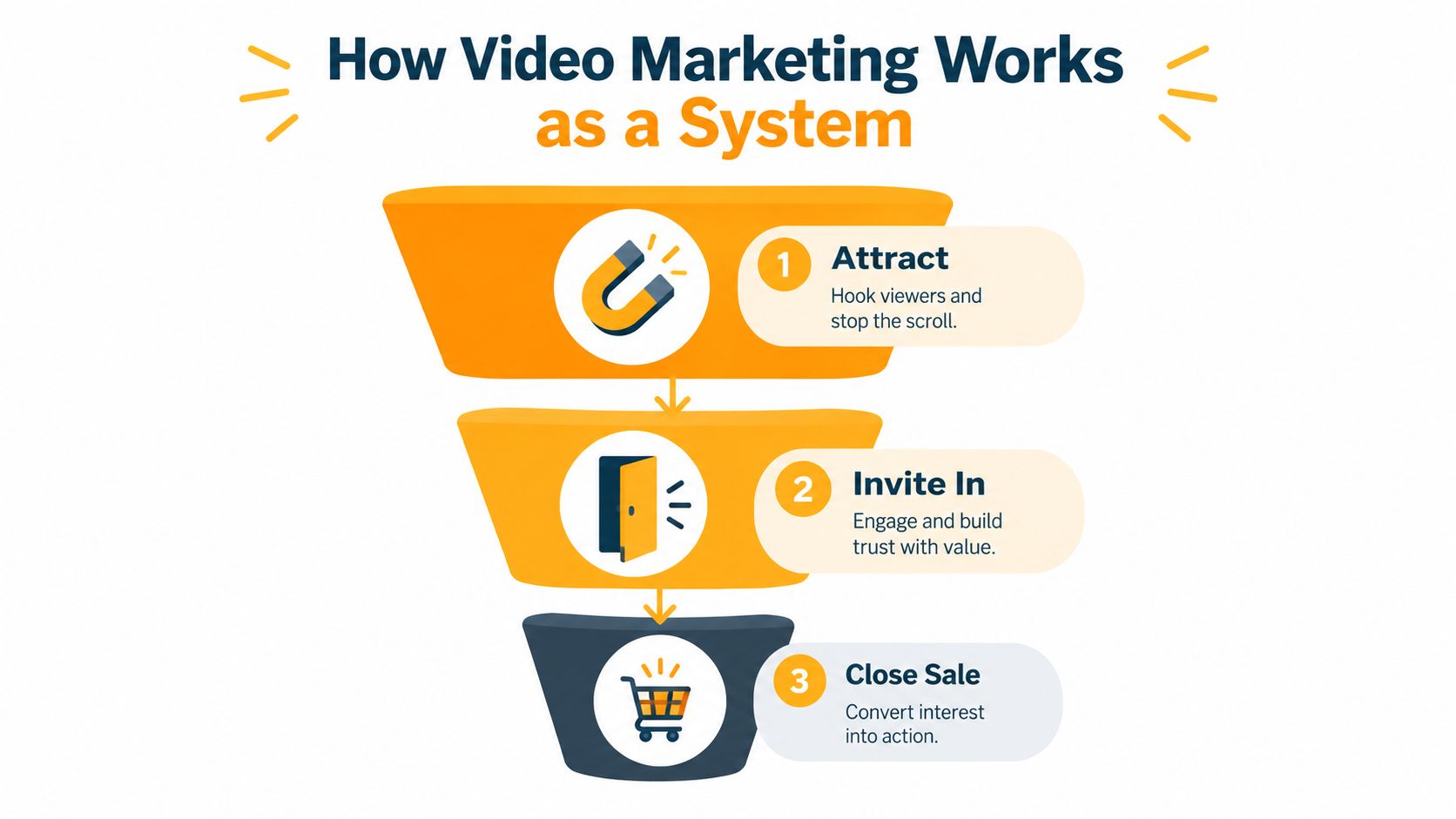
Attract attention fast
The first job is the hook. A thumbnail, first line, opening visual, or surprising product moment has to earn a few more seconds. If that opening is vague, the rest of the video barely matters.
One benchmark found an inverted U-shaped relationship between video length and engagement, with an optimal length of 34.69 seconds (video conversion statistics). That doesn't mean every video should be exactly that length. It means attention has a budget, and viewers start dropping when the message takes too long to get clear.
Invite people in with value
After the hook, the video needs to reward attention. Show the product solving the problem. Demonstrate the result. Teach one useful thing. Answer the objection the viewer is already carrying.
Many brands overtalk. They add intro graphics, broad brand lines, and scene changes that look polished but don't increase understanding. Better videos keep introducing new cues. A new angle. A clearer proof point. A concrete benefit.
If viewers can't tell what they're getting in the first few seconds, they usually won't stay long enough to appreciate the creative work.
Close the loop after the click
The system doesn't stop when someone watches. The landing page, product page, or checkout flow has to match the promise the video made. If the video says “see how it works in 15 seconds” and the click lands on a busy homepage, you've broken the path.
A practical plan looks like this:
- Hook first: Lead with the clearest problem or payoff.
- Proof second: Show the product, person, or process in action.
- Next step third: Tell viewers exactly what to do next.
- Match the destination: Make sure the post-click page continues the same story.
That's why video marketing works best when creative, distribution, and post-click experience are planned together.
Main Types of Video Marketing You Can Use
Not every video should do every job. A short social clip and a product demo can both be good, but they solve different problems.
Match format to intent
A shopper who has never heard of your brand needs a very different video from a buyer comparing two products. Early-stage viewers need clarity and curiosity. Mid-funnel viewers need explanation. Late-stage viewers need confidence.
Short-form is often the fastest way to earn discovery. Explainers and demos do more of the heavy lifting once someone cares. Testimonials help when the viewer is asking, “Will this work for someone like me?”
For creators trying to tighten their pacing and scripting, this guide on short videos that actually perform is useful because it focuses on what makes compact videos watchable instead of just shorter. If you want a broader catalog of formats, this roundup of types of videos helps map each one to a use case.
Choosing the Right Video Type for Your Goal
| Video Type | Best Funnel Stage | Primary Job |
|---|---|---|
| Short-form social video | Awareness | Stop the scroll and spark interest |
| Paid video ad | Awareness to conversion | Drive a click or product visit |
| Explainer video | Consideration | Clarify how the offer works |
| Product demo | Consideration to conversion | Show the product in action |
| Tutorial or how-to | Consideration to loyalty | Teach, reduce friction, build trust |
| Testimonial video | Conversion | Reduce doubt with social proof |
| Shoppable video | Conversion | Let viewers move from watching to buying |
| Localized variant | Any stage | Make the message feel native to a market |
The useful question isn't “What's trending?”
The useful question is, “What does this viewer need right now?”
- Use short-form clips when people need a quick reason to care.
- Use demos when the product needs to be seen, not just described.
- Use tutorials when buyers hesitate because they think the product looks hard.
- Use testimonials when trust matters more than novelty.
- Use variants when the same idea needs different aspect ratios, languages, hooks, or calls to action.
The smartest teams don't make one hero video and hope it fits everywhere. They build a core message, then adapt it to context.
Benefits and ROI That Make Video Essential
Video earns budget because it can do more than one job at once. A strong product clip can introduce the brand, explain the offer, answer objections, and drive a click in the same viewing session.
That's part of why the market around video keeps expanding. One 2026 industry summary projected global digital video ad spending at about $223.5 billion for 2026, rising to $241.9 billion by 2028. The same summary also notes that 2024 spending was $191.4 billion, up from $173.5 billion in 2023, which shows how quickly money has continued moving into video inventory (video marketing statistics for creators 2026).
Here's the business case at a glance:
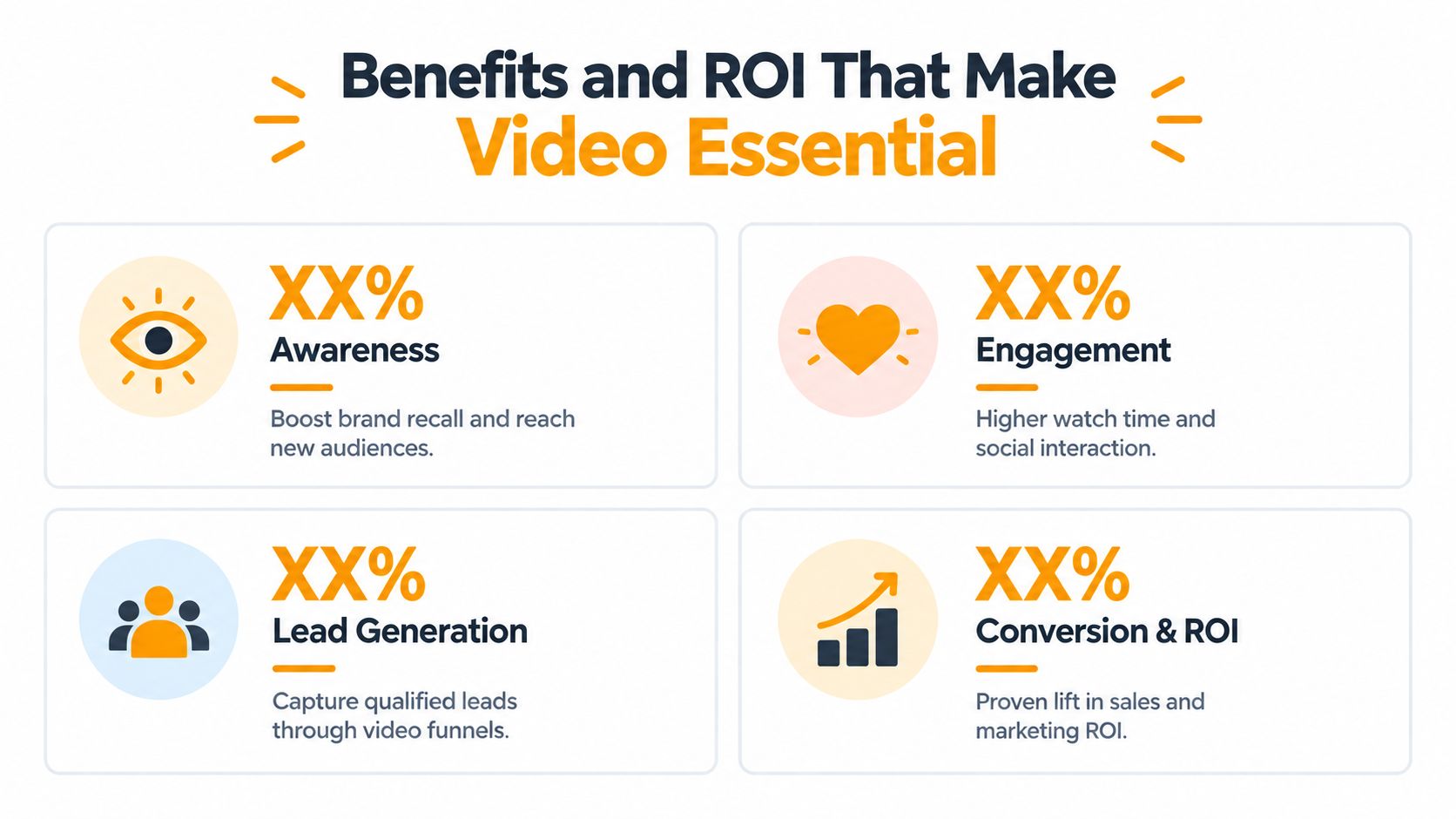
Why marketers keep leaning in
The strongest argument for video isn't hype. It's that teams can use it across awareness, engagement, lead generation, and conversion without treating each step as a separate content universe.
Recent coverage also points to a production shift. One 2026 summary says AI-driven workflows have reduced median production cost per finished minute from $4,200 to $2,500, while also reinforcing that teams increasingly expect video to support shoppable and personalized use cases, not just storytelling (2026 video marketing data points). If you're exploring scalable creation, this overview of automated video production shows how that workflow mindset changes content planning.
Short-form leads on reported ROI
HubSpot's 2026 marketing statistics page says short-form video is the top ROI-driving content format at 49%, ahead of long-form video at 29% and live-streaming at 25% (HubSpot marketing statistics).
Short-form doesn't win because it's short. It wins because it matches how people discover products now, then hands off to deeper assets when they want more detail.
That's the takeaway. Video is no longer a side format for brand teams. It's a working part of growth.
Platform Playbook for TikTok Instagram Reels and YouTube
The same idea rarely works unchanged on every platform. A vertical clip that feels native on TikTok can look cramped on YouTube. A polished horizontal demo can feel too slow inside Reels. Good video marketers don't just repost. They recut.
TikTok and Reels reward immediate clarity
On TikTok and Instagram Reels, viewers often decide in a moment whether to stay. That pushes you toward visual hooks, on-screen text, and sound-off clarity. If the concept depends on a slow introduction or audio alone, it's fragile.
Recent trend coverage also notes that short-form remains the default, that videos should be optimized for sound-off viewing, and that “searchable video” is growing inside social platforms, which changes how creators title, caption, and phrase their opening lines (video marketing trends for 2026).
YouTube works in two different modes
YouTube Shorts behaves more like discovery media. Long-form YouTube often catches people with higher intent. They're comparing products, learning a skill, or checking whether your offer is credible.
That difference changes the edit:
- For TikTok: Start with the pain point or surprising result.
- For Reels: Keep the pacing tight and use captions that still make sense without sound.
- For Shorts: Make the topic instantly legible and tie the ending to a next watch or click.
- For long-form YouTube: Spend more time on explanation, proof, and structure.
A platform is not just a place to upload. It changes what the first five seconds need to do.
One idea, many cuts
A single product launch can become a vertical teaser, a captioned demo, a searchable FAQ clip, a creator-style UGC ad, and a horizontal walkthrough for YouTube. The message stays consistent. The packaging changes.
That's what modern video marketing looks like in practice.
From Idea to Distribution With Faster Workflows
Production gets easier when you stop thinking in terms of “make one video” and start thinking in terms of “build one message system.” The source material might be a product launch, customer problem, feature update, or seasonal offer. From there, the job is to turn it into reusable parts.
A lean workflow that scales
A practical workflow usually looks like this:
- Define the angle: Pick one problem, promise, or product moment.
- Write the core script: Keep the message clear before you decorate it.
- Choose visual proof: Product footage, screenshots, motion graphics, UGC-style clips, or founder delivery.
- Add accessibility layers: Captions, readable text, and sound-off logic.
- Create variants: Vertical, horizontal, shorter cuts, localized lines, different hooks, different CTAs.
- Distribute and test: Publish by placement, then compare what holds attention and what drives the next step.
AI can help, but only if the workflow stays controlled. Templates, approved assets, fixed brand colors, and consistent calls to action keep speed from turning into chaos.
Where tools fit
Teams now use a mix of editors, captioning tools, voice platforms, and automation layers. In that stack, RemotionAI is one option for generating platform-ready videos from plain-language prompts, including real Remotion React code, ElevenLabs voiceovers, animated captions, and vertical or horizontal templates. That matters when one campaign idea needs multiple edits without rebuilding every asset by hand.
If you want a broader view of how AI is changing ad production, the Crank 11 AI ad guide is a helpful read because it focuses on creative iteration and deployment, not just novelty.
The operational mindset that helps most
The best workflow change is simple: approve the message once, then adapt the packaging many times.
That lets a small team produce a shoppable cut for paid social, a localized version for a regional market, a cleaner explainer for YouTube, and a shorter hook-first version for TikTok without drifting off-brand. Speed matters, but consistency matters more.
Measuring What Matters Beyond Views
Views can tell you a video was served. They don't tell you whether it helped the business.
Good measurement follows the funnel. Did the video earn attention? Did it create enough interest for a click? Did the landing page continue the promise? Did the visit convert?
Use metrics that match the placement
One marketing analysis reports that YouTube end-screen CTR commonly falls in the 2% to 10% range, card CTR in the 0.3% to 2% range, and session conversion rate from video traffic is about 0.5% to 2.5% for social video in e-commerce and 1% to 4% from YouTube long-form, depending on landing-page quality and audience intent (video marketing statistics and benchmarks).
Those numbers are useful because they force a better question. If watch time looks healthy but clicks are weak, the problem may be the CTA or the post-click offer. If clicks are strong but conversions are soft, the landing page may be breaking continuity.
A simple diagnostic framework
Use this lens when reviewing performance:
- Creative problem: People don't hold. The hook is weak or the message gets muddy.
- Distribution problem: The right video is showing up in the wrong place or to the wrong audience.
- Post-click problem: The landing page doesn't match the promise or creates friction.
Track the handoff, not just the headline metric. A video can look strong on-platform and still lose money after the click.
What to watch besides views
A better scorecard includes:
- Hold rate: Are people staying long enough to get the message?
- Click-through behavior: Are they taking the next step?
- Click-to-visit match: Does the destination feel like a continuation of the video?
- Session conversion: Do those visits produce revenue, leads, or sign-ups?
- Variant performance: Which hook, caption style, CTA, or localization wins?
That's where confidence comes from. Not “this video got attention,” but “this version earned attention, moved people forward, and justified another round.”
If you want to turn this full-funnel approach into an actual production system, RemotionAI helps you generate platform-ready videos from plain-language ideas, then adapt them into vertical, horizontal, captioned, and branded variants without rebuilding from scratch. It fits the way video marketing works now: one core message, many assets, measured by what they move, not just what they reach.